Monday, August 25, 2014

On the Road Again... Part 3


At the John Deere Museum in Moline, Ill, it becomes clear why this Ettlin (above, at the wheel) will never cut it as a farmer. (Photo by Bonnie J. Schupp)

Harvesting entertainment

across the Midwest

CEDAR RAPIDS, Iowa – Leaving Lafayette, we crossed the border from Indiana into Illinois for lunch and a few hours of conversation with long-ago Baltimore Sun colleague Pete Wetmore and his wife, Marge – a result, in part, of Pete finally joining Facebook and our line of communication opening through cyberspace.

I hope that description amuses, seeing as how Pete was one of the architects of The Baltimore Sun’s early days in the development of computerized writing and editing systems. He was one of the newsroom wizards, as well as being a talented editor. And his departure from the newspaper a good quarter-century ago to move back to his Midwestern roots was an incredible loss for the newspaper.

The Wetmore home in Urbana dates to around 1850, and likely was passed by Abraham Lincoln. Built in the foursquare style, It is one of the oldest homes there -- a survivor of an 1871 fire that consumed much of Urbana, the same year as the Great Chicago Fire. The fire began behind the property, Pete says, and the wind was blowing away from the house. It, the couple’s prized garden, and Marge’s extensive collection of quilts dating back more than a century are all pure Americana.

After bagels, deli and salad, Bonnie photographed the Wetmores for her slowly growing “40-Plus” project exploring the question of what glue (other than love) holds couples together 40 years or more. This was a little bit of a cheat, since they’ve only been married for a bit over 39 years. But it’ll be 40 or more by the time the project reaches the exhibition stage.

Visiting Jane and Larry

From Urbana, we headed for the interstates to whiz across Illinois and spend two nights with a former teaching colleague of Bonnie’s at Anne Arundel County’s George Fox Middle School – Jane Moberg Ladwig and her husband, Larry Ladwig. After her retirement, Jane had moved back to her Midwestern roots in eastern Iowa and, after her marriage to Larry, across the Mississippi to East Moline, Ill.  Both had lost spouses about the same time in the late 1990s, and met by chance on a golf cart ride along an area riverfront trail.

Jane’s background includes years spent as a nun teaching in Africa, in Tanganyiki (now Tanzania). Each meal in their home began with us holding hands while she would offer a prayer of thanks. We didn’t talk about religion, beyond noting that Bonnie is herself an ordained minister... through the online Universal Life Church. But in the minutes before we left them, Jane allowed as how we were quite different in our views but she was thrilled that we had come and shared time with them. And I noted my sense of place, in that we are all bound up together in a universe immense beyond comprehension. And Bonnie added, “Bottom line...we are all related.”

The Ladwigs took us on a tour of their so-called Quad Cities region on both shores of the Mississippi,  originally Moline, East Moline, Davenport and Rock Island, but now with a fifth, Bettendorf. But they haven’t changed the name to become the Quint Cities – apparently that just didn’t sound right.

Our first stop was the John Deere Museum in downtown Moline, where farm equipment ranging from early tractors to a giant harvester costing more than half a million dollars is on display. Much of it is open for kids to climb in and play farmer, as do at least as many adults. I played pretend in the cab of the giant harvester, and tried to ignore the 9-year-old kid waiting by the cab for his turn. There is a sense of wonder sitting at the wheel of huge machinery. You can even operate simulator versions of some of the big stuff, pulling the levers in front of video projections bordering on virtual reality.

The museum also had an operating robotic lawnmower -- sort of a Roomba for grass, guided by patterns placed around a property to avoid straying, or cutting down the wrong stuff. A sign noted it was not yet available in the United States, but it seems only a matter of time. The mower, the Tango E5, weighs 33 pounds, posing a question about how folks will keep the thing from getting stolen.

After a sandwich lunch in an old-time Moline soda shop, Lagomarcino’s, we crossed the river for a visit to Le Claire, Iowa, at the Antique Archaeology headquarters of the popular cable TV History Channel show “American Pickers.”

With sunshine breaking out after a rainy Friday night, the place was packed with tourists gawking at the odd and eclectic collection of stuff, much of it acquired from amid the junk people don’t throw away that is culled through on the program by its stars Mike and Frank. Neither was there – nor was my favorite, their assistant Danielle, although her sister Annie had stopped by. She looks and sounds much like Danielle, and seems to sport at least as many tattoos as her sister.

Annie happily went along with my suggestion that she play photobomber as Bonnie took a cellphone selfie of us.

The show site attracts many bikers, particularly since Mike is a motorcycle enthusiast and collector. Outside, a couple of well-attired bikers, Adam and Joe, posed for photos – including a terrific one of Jane, sitting between them. (A similar shot of me will have a cameo appearance as my Facebook banner photo.)

                          Jane sits between Adam (left) and Joe, while Annie (above) plays photobomber.

My only regret as we finished the afternoon drive was that the local minor league baseball team, the Quad Cities River Bandits, did not have a game scheduled until Sunday in their home, Modern Woodmen Park. Photos of their stadium interior look like a homerun hit hard enough could splash down in  the river.

Instead, on Sunday we bade farewell to the Ladwigs and set off for a few days exploring Iowa. Surely there was more than cornfields. And that’s how, on a meandering drive heading initially for Iowa City, we detoured to Maquoketa (Mack-o-keeta) Caves State Park. After hearing a required brief talk on the problem of a deadly white-nose fungus that is killing millions of bats across America, we rubbed our shoes on a sanitizing mat and headed down a series of steps to explore the few caves that are high enough to stand in and walk through. With temperatures outside rising into the low 90s and Baltimore-like high humidity, the caves were a breath of nature’s air conditioning. Trouble was, we eventually had to climb back up the steps to get back to our car.

Kids are not as picky. We saw some who had eagerly crawled through some of the low-passage caves and emerged slathered with mud. It was very slippery everywhere, though, from the water constantly dripping from the limestone formations. And it is one of the least-accessible places for the disabled that we have ever seen. (We can’t imagine how that could ever be affordably changed, given the steep, rocky topography leading to the caves. I can more readily see people becoming disabled trying to get through them!) Admission to the state park is free.

Leaving the caves, we found ourselves on country roads labeled as Grant Wood Scenic Byways – through the Iowa countryside that was the focus of much of the work of the famed American artist born in the nearby town of Anamosa. We looked without success for a recreated version of the house depicted in his famed painting American Gothic, but found a Chamber of Commerce office with exhibits including the seemingly endless parodies of its sturdy, deadpan farm couple with the pitchfork. There’s even an American Gothic clock on the wall with the faces of Barack and Michelle Obama.

The volunteer on duty there in late afternoon was 78-year-old Jon Hatcher, a survivor of numerous serious illnesses in recent years and wearing a heart monitor that he said was connected to a site in Pennsylvania that would trigger defibrillation should his heartbeat become erratic. He snapped a picture of Bonnie and I putting our faces into a wooden cutout of the Gothic couple, and I posed as a photobomber behind a standing cutout of the farm couple. The building had been a bank years back, and Jon led us to its old Diebold safe, with a door so heavy you had to strain to open it – and two more locking doors inside it.

The nearby restaurant had already closed, and the closest place for food there was a McDonald’s – but Jon said if we rode four miles down the byway to Stone City, we’d find the General Store Pub. The food there is mostly fried, he said (“A little grease won’t kill you.”), but after 4 p.m. on Sundays it features open-mic entertainment. (“If they’re no good, they yank ‘em off the stage.”)

We arrived at the two-story building in time for a very nice bluegrass-style band, followed by the spirited a capella rendition of some old standards by 83-year-old Ruth Janey from Cedar Rapids, perched on the seat of her walker. I told her she reminded me of my Aunt Alice, who died late last year nearing the age of 107 – and how my aunt’s favorite song had been “Enjoy Yourself (It’s Later than you Think).”  Ruth closed her set of about eight condensed versions of the old songs with “As Time Goes By.”

Nobody offered a “Play it again, Ruth,” but she was warmly applauded by what seemed to be a crowd of mostly local folks. 


                                Ruth Janey listens to the bluegrass group preceding her performance.


After our dinner of deep-fried and somewhat overcooked chicken fingers, and a half-pounder supposedly grilled hamburger (but not the double-patty American Gothic version costing an extra $5, for which the menu says “you may need a pitchfork”), we were off to Cedar Rapids and another Holiday Inn Express. It wasn’t quite as nice as the amazing motel in Greenfield, Ind., and at 20,000 points I opted to pay for this one. The clerk said the rate was $129, and just a little less with our AAA discount. The reservation agent I was talking to at the same time by cell phone, from the lobby side of the check-in desk, made it $99. And we got the upgrade to a king room that, this time, lacked the mini-fridge and microwave.

But the motel was clearly an older property, judging by the condition of its furnishings, and the main lamp by the couch had a balky switch and a burned-out bulb. Our clerk found time to come by with a replacement bulb, however.  And we slept just fine after a good time on a hot day along some blue highway.


Thursday, August 21, 2014

On the Road Again... Part 2


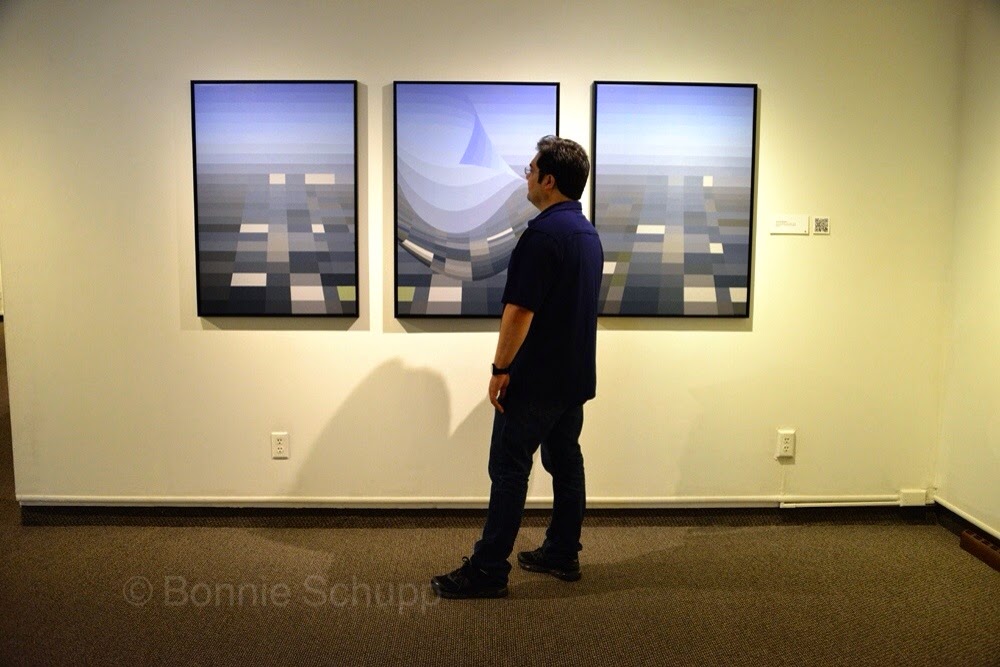
Petronio Bendito, with his three-panel rendering of New Orleans' Katrina disaster; and (below) the artist with his response to Haitian earthquake. (Photos by Bonnie J. Schupp)

Turning darkness into light:
Responding to tragedy through art


LAFAYETTE, Ind. – Petronio Bendito renders scenes of horror into art. Images of the aftermath from tornadoes, tsunamis, earthquakes are analyzed to create color palettes, and from this digital tray of paint strips the Brazilian-born artist creates powerful abstract imagery.

The shaking of buildings in 2005 in Pakistan becomes shimmering bands of ribbon in dark and light shades of collapsing concrete. The various-color  uniforms of an international group of rescuers surround the brown of the skin of a child being pulled from rubble of a Haitian earthquake in 2010. A man  carrying a child through floodwaters in China, 2007, becomes a powerful cocoon of red. A ribboned wave, the heavily blue swirl of water, curls over the coast of Thailand. There’s the raging orange/red of flames of the Colorado Springs forest conflagration. A seeming teardrop symbolizies the rush of water over New Orleans during Hurricane Katrina.

Our  friend Petronio, who teaches art here at Purdue University, is why we have come to Lafayette. Bonnie met him through the International Visual Literacy Association, a largely professorial group she joined while working on her doctorate in communications design a decade ago at the University of Baltimore. He participated in her “Defining Ourselves” project with an answer so simple yet profound (“I am all that I love.”) that we drove here a few years ago for her to take his related portrait photo. We’ve kept in touch through Facebook, and spent a day with him in Baltimore this year when he was presenting a program on color and algorithms at a mathematics conference. He’s brilliant, to say the least.

W had talked about his natural disasters project – using photographs of disaster scenes as the basis for creating art – and wanted to see the entire display, hanging through early September in the Art Museum of Greater Lafayette.  (It moves  later next month to the Central Features art gallery in Albuquerque, New Mexico.)

Petronio received an Indiana Arts Commission grant for the project, but early on found the work emotionally troubling – three months into the project unable to continue because it was overwhelming. But with the encouragement of friends, some of them psychologists, he managed to keep going. He developed an understanding that what matters is how one responds to disaster and tragedy – because life goes on, even though changed.


There is a glass case of the source photos next to the corresponding color palettes. And there are quotes on the walls, like this from Carl Jung: “I am not what happened to me. I am what I choose to become.”

And from author-motivator Leo F. Buscalgia: “There are two big forces at work, external and internal. We have very little control over external forces such as tornadoes, earthquakes, floods, disasters, illness and pain. What really matters is the internal force. How do I respond to these disasters?”

Buscalgia also is quoted: “Death is a challenge. It tells us not to waste time.... It tells us to tell each other right now that we love each other.”


And from an anonymous writer, the likes of whom are on seeming eternal proliferation through cyberspace: “You never know how strong you are, until being strong is the only choice you have.”

Petronio’s strength grew as he explored the world of tragedy, and says the lesson he took from it all was how he must respond – trying to improve the world in the aftermath, to heal.

One of Petronio’s observations: “Perhaps one of the greatest virtues is the alchemy of turning darkness into light, pain into lucid moments of reflections, loss into new findings and meanings.”

Also among the wall quotes, the artist adds: “The kaleidoscope of life gives us many color combinations, but we must pause to see them.”

Looked at closely, the art pieces are a journalistic distillation spun out in powerful arrays of color and motion instead of words.  Within his art lies great truth.

After our tour of the museum show, we split up for two hours – Petronio to deal with some matters of art and academia, while we explored Lafayette’s Main Street and found Jan Wright’s little shop of curiosities – First Class Clutter. Reminiscent of the eclectically surprising shops of used stuff and antiques in Baltimore’s Hampden and Fells Point neighborhoods, Clutter was almost as entertaining as Jan herself. She shared some of her collection of funeral photos – one of them showing a laid-out Al Capone – and, from her love of aviation, a few photos of the ill-fated Amelia Earhart taken at Purdue University.


                                                   Jan Wright, in her store First Class Clutter

Planes hang suspended from the shop’s ceiling, sort of flying over the bric-a-brac of American civilization that’s piled on shelves or hanging throughout the establishment. Old dish sets, boxed silverplate cutlery, sheet music, vintage clothing, photos of mostly anonymous people once stowed in boxes or mounted in treasured family albums – faces out of time, yet timeless.  I could have stayed there for hours, but our time was more limited – dinner and conversation were waiting, with Petronio and his partner Bryan Bell back at their home.

Lafayette is a lovely place, but the best part of travel for us remains the people we encounter and get to know as friends. They enrich our lives.


Wednesday, August 20, 2014

On the Road Again...


 Terry and Pam Dornburg lean on the fence, watching softball action in Grantsville. (Photo by Bonnie J. Schupp)

Getting away ain't easy these days


The hardest part of a road trip may be getting out of the house, into the car, down the street and around the corner. Then don’t look back

It’s been a long time since our last real road trip... 2008, really, when we set out for Appalachia in search of Democrats. We had other trips, shorter adventures, and airplane rides. But this is totally roadie, and it’s not political – not yet, anyway. After all, you never know what you might encounter on the highway to somewhere else. Serendipity, good luck, bad luck. It’s all out there, lying in wait.

One thing we won’t be having is hitchhikers. No room in the car. It’s packed with electronics, clothing, meds, snack food, bottled water, extra shoes, sweatshirts and jackets, our own pillows. We’re gone for more than a month this time, and we’re probably going to outlast summer.

The journey is really the fault of my nephew Ross, who chose the bicentennial anniversary of The Star-Spangled Banner to get married. The kid is from the Baltimore area, but fled – to Aspen, Colorado, where he owns a pet supply shop in the center of town. And that’s where the ceremony will  take place on Sept. 13 as he  weds a dog trainer.

Family is important, so missing the wedding was not an option.  But why fly when you can drive... to Colorado, and lots of places between here and there before we’re back again.

So we packed the car, and packed, and packed. Times like these I miss the 30-foot converted school bus camper I owned in the 1960s, two wives back. The damn thing could sleep eight people. Or a few years later, the 1945 Ford mini-bus with custom wood cabinetry, a brick fireplace and a stovepipe chimney. But the 2012 Toyota Camry will have to suffice.

We should have left in the morning on Monday, but a friend prevailed upon my wife Bonnie on short notice to shoot his family – photographically speaking. It was a rare occasion when his entire family was under one roof – some from New York, some from Israel, even his 98-year-old mother-in-law. Like I said, family is important, even when it may be someone else’s.

So when the road trip began, it was 4:45 p.m., just in time to head westward into the maw of rush hour traffic fleeing Baltimore and Washington. It wasn’t pretty or efficient, but Interstate 70 finally opened up and we made it to Frostburg in Western Maryland before sunset.  We might have stayed there, except I got tired of being on hold for a reservation agent at Days Inn’s 800-number. So we drove through town along Main Street and picked up old U.S. 40, once known as The National Road,  all the way to tiny Grantsville.


                   Me, sitting on the porch of the historic Casselman.


It was a stroke of luck, really, stopping there at the historic Casselman  Inn, a registered historic site  which dates to 1840 and once catered to the stagecoach crowd. There's also a 40-room Casselman motel section in back. But the old building is still in use, with a few rooms and a quaint restaurant, run along with the motel by Mennonite folks who constitute a fair measure of the population in remote Garrett County. Most of the staff seemed to be Mennonite, but I noticed one dark-complexion there... a man repainting one of the sitting rooms, who turned out to be an Iraqi. He spoke a little English, and I got across that I was sorry his country was such a mess and hoped it would be mended some day. I was told the Iraqi chap is attending the local Mennonite church.

A longtime resident of the hotel (he checked in more than 40 years ago, and apparently never checked out) was sitting in a rocking chair on the porch, watching not much happen. Cars were few, as has been the case since Interstate 68 opened to traffic and bypassed the old two-lane stretch of highway in front of the Casselman. I asked if much was going on for local entertainment, and he pointed up the road where, a short distance away, you could see the ballfield lights in the town park.

So after a picnic dinner in our very clean, but somewhat austere, room (about $62 a night, including taxes), Bonnie and I strolled up to the park, caught the last inning of a church league slowpitch softball game between  Mennonites from Grantsville and Mennonites from Bittinger, a few miles away.The oldest players were the ministers -- Grantsville's at third base, Bittinger's pitching.

A middle aged Mennonite couple leaned at the fence, and I nudged Bonnie pointing them out as a charming image, and she walked over to ask permission to take their picture. Terry and Pam Dornburg were happy to say yes, and inquired about us strangers... so we explained how we’d just driven about 170 miles from the Baltimore area on our first leg of the long road trip.

                                                                         Pam Dornburg

Pam gave Bonnie a warm hug, quick proof of the friendliness of little Grantsville. Her husband, Terry, is a dentist. And they were watching one of their sons play outfield, while a younger son, a few days short of the minimum age of 15 to play in the league, was among about two dozen other spectators.

When the game ended, with Granstville on the losing end of a slightly lopsided score, Pam gave Bonnie another hug and we all shook hands. Then we walked back to the Casselman for a little sleep time.

You’d think we’d know better, embarking on Day 2, to get an early start since our goal was to reach Indiana – some 400 miles. But after an excellent breakfast of eggs, bacon and home fries, we backtracked no more than half a mile to see the historic stone arch bridge over the Casselman River, built some 200 years ago to accommodate traffic across what was then the National Trail. The bridge was in use until 1933, and remains as a remarkable specimen of early 19th century engineering – the centerpiece of a small state park

We walked across the bridge and found ourselves in the tiny Spruce Forest Artisan Village, where arts and crafts folks – a weaver, potter, blacksmith, photographer, among others – work and sell in restored and transplanted homes from the area in the early days of America. That, and the beautiful flower gardens outside several of the buildings, were a grand excuse to delay our departure.

And then, a little past 11 a.m., after half an hour talking with weaver Ann Jones (we had met her a year or two ago in Baltimore when she took part in the annual Maryland Traditions Folklife Festival) and a guest artist photographer, we were back in the car – 400 miles to go before nightfall.

Other than a roadside piece of whimsical humanoid sculpture made from metal scrap – including the springs of an old mattress as its torso – the drive was relatively unremarkable. We managed to avoid bad weather until shortly after crossing the Indiana border, where an extraordinarily high cross looms to the north side of Interstate 70. If there is a god, as many Indianans would insist, it was not a happy one. We had to navigate through a deluge of rain and fierce lightning. We saw what looked to be a tornado funnel, but it turned out to be an immense amount of rain pouring out of the edge of the dark bank of clouds.

It was time to search for a hotel, so we used the cell phone to see what might be available nearby in the way of a Holiday Inn Express – a chain that has upgraded very nicely in recent years, and proven consistently good. Besides, I hold a credit card from the hotel parent corporation, IHG, that has accrued some 92,000 points redeemable for discounts or better.

We did much better. The room we wanted in the town of Greenfield would have run about $125 with our AAA discount. I asked the reservation agent if I could lower the price by using some of my points -- like what would it cost with 10,000 points? Answer: Nothing. The room, with the standard two queen beds, was free. 

Twenty minutes later, reservation number in hand, I bantered happily with the motel room clerk. She  noted that I was a "platinum" IHG Rewards member (a status you get by paying for the $49-a-year credit card), and gave us an upgrade to a king suite. It was an incredibly nice room, with extra furniture, a fridge, desks and chairs,  and a king bed with soft pillows that felt so darn good. So thanks, IHG Rewards -- and a shout out to the folks who staff the motel in Greenfield. You do a great job, and the company owes you a big raise.


Thursday, December 19, 2013

Farewell Aunt Alice, at 106

         Alice (fourth from left), in show as a young woman,  and below with brother Ben, about 1952.

The year 1907 sounds so distant. But it grew even more so today as we buried my Aunt Alice, who died this week at the age of 106-plus. 

Alice Ettlin Krupsaw was born on Feb. 28, 1907. Her parents Louis and Ida Ettlin were Jewish immigrants from the Russian Ukraine who largely achieved the American dream, although they never became American citizens. Ida, my grandmother,  mostly spoke and only read in Yiddish.

Louis Ettlin  was a tailor, working in department stores and for a time his own Baltimore shop at the southeast corner of Calvert Street and North Avenue. Several relatives from the old country also had tailoring businesses around the city.

In a memoir included in a book of her poems, paintings and family photographs, published for Alice's centennial birthday, she recalled early childhood years on Eagle Street, "Little Israel," in the city's southwestern corner and on Monroe Street a few miles to the north -- a house more modern, since it had electricity.

"And what a great time my brother Ben and I had running into every room, pushing buttons just to see the lights go on," she wrote.

A house with electricity, papa's "Tin Lizzy" car with a crank-operated starter, an ice box refrigerator that needed a 10-cent block of ice to keep stuff cold. It was another world back then.

Yet she lived to see man set foot on the moon, and marveled as recently as three weeks ago at how a great-nephew could take her picture with his SmartPhone and immediately show her the image on its screen display. She marveled at videos of herself singing that appeared as if by magic on my laptop computer, and was delighted -- even if she could not fathom how it was possible -- that thousands of people across the planet had also seen her, on YouTube.

Alice attended high school and Strayer's secretarial school, and was about 22 when she married Louis Krupsaw, a cook and former Marine who later was to serve in the U.S. Army. They operated a delicatessen for a short time in Baltimore, but no one can remember when or exactly where. I heard once that it was on Gay Street. The only evidence is the rudimentary start of a novel Alice tried to write in pencil -- on brown butcher paper.

Judging by the dates on photos, Alice and Lou moved to Washington about 1950. He became a route delivery man for the old Washington Daily News, and Alice began a series of jobs with federal government agencies -- the mint, the printing office and Walter Reed Army Hospital. She enjoyed telling about the time she delivered a set of President Dwight Eisenhower's X-rays to a White House official, and of meeting First Lady Mamie Eisenhower.

Lou died in 1955, and was buried in Arlington National Cemetery. He was just 56 years old, and they'd had no children.  He left her with memories of their numerous trips, to Florida, out west, and to Havana, Cuba. Pictures, most of them faded from the passage of years, show her in the various locales, including riding horseback with Lou. And there's souvenir photos from fancy restaurants, like Club Cairo in Northwest Washington, where they celebrated a few of her birthdays in the late 1940s.

Alice never remarried. And eventually she took a lesser clerical position in the Baltimore suburbs at the Social Security Administration headquarters -- close to the home of her parents, so she could better help them in their declining years. She retired in 1975, and might have become the oldest living retiree of the SSA. (The agency professed last year, as we planned for Alice's 105th birthday, not to have such records.)

In 1977, she took painting classes at the Waxter Senior Center in downtown Baltimore, and began turning out works on canvas that one might classify as primitive art -- my favorite was a painting depicting two young children pulling a sled down a snowy country lane toward a farmhouse. They were some of the children she never had.

Alice made most of her own clothes. Her baby brother Sam, now 94, recalls asking if she could make covers for his golf clubs. She knitted them -- sort of like sock puppets, each with a whimsical head. Then she thought about making smaller ones, as finger puppets about 3 to 4 inches long, perfect for children to play with. And in the ensuing years she made countless hundreds of them, each taking about an hour and a half to create. She donated them to hospitals, schools and children's homes around the country and in Israel -- and more golf club covers for charity sales.

She kept the thank-you letters and notes from the various recipients, and the letter from Jerusalem informing her that she had been named an honorary member of the Diskin Orphan Home of Israel. But my favorite from her scrapbooks is dated Dec. 13, 1991, from a boy named Adam:

"Dear Alice," he wrote. "Thank you for the finger puppet. I might make a puppet show. I named it Freddy. It is a he. I have a gerbil named Freddy. My cat knocked it over."

She filled her apartment with dolls, human and otherwise, and dressed them in clothes she made. They were also her children, and she created an elaborate Jewish wedding scene for some of them. 

Alice wrote scores of poems. She wrote them by hand, and then typed them, over and over, for more than 30 years. Some of them are pretty good -- so good, I worried she copied them from somewhere. Google searches never turned up a trace, however.  

She had two reference books tucked in a worn-out satchel of her writing -- an old dictionary, in which Alice had written words with their definitions and synonyms inside the front and back covers, and a Gideon bible with a stamp suggesting she obtained it in some manner from the Walter Reed hospital. I joked with the cantor preparing for Alice's funeral that I was sure she read only the Old Testament part.

Ten years ago, Alice lost a leg to a blood clot. She had to move permanently into a nursing home,  Milford Manor -- abruptly giving up her apartment and the battered car that appeared from its many dings she had parked mostly by Braille.

For years, Alice had performed as a singer and dancer -- there's a picture of her, above, in a troupe of entertainers for some program lost in the mists of time. But in her later decades, she appeared with seniors entertainment troupes that played mostly to audiences in senior centers and nursing homes. She'd often say she never imagined herself as being part of the audience, in a wheelchair.

Ten years in a nursing home is, frankly, unimaginable. She found herself surrounded by aging, helpless people who mostly were unable to communicate or deep into dementia, but gradually she adapted and tried to make the most of her situation. Her poetry began appearing in monthly editions of the Milford Manor news bulletin. She enjoyed bingo, and slipping the nickels and dimes she won to her great-great-nephew Jadon Axe for his college fund. She won a lot of nickels and dimes, but not that many!

Alice had a mantra that she would chant to visitors and nursing home aides, about how they should make every effort to fulfill their dreams, while they had healthy minds and bodies. "Do it now," she would implore them. "Do it now."

She would on occasion sing, as best she could, her favorite song: "Enjoy Yourself (It's Later than You Think)" -- and on  her 101st birthday, my wife Bonnie Schupp got that on video. She put it on YouTube, and the number of viewers slowly grew. It was at nearly 2,000 when CNN broadcast journalist Josh Levs included an excerpt in his Saturday afternoon feature on viral videos.

As of today, it has had more than 10,100 views -- and you can add to that count with this link: http://www.youtube.com/watch?v=W5TBwJF0v1g

Alice on many occasions would marvel at having lived so long. One of her regular visitors was my brother Larry, who died in 2009 at the age of 70. "Poor Larry," she would say, and had a hard time understanding the whys of death for those much younger than herself. 

"Who wants to live like this?" she'd say as the years of dependence in the nursing home mounted. "But what's the alternative? I don't want to die."

On good days, Alice would wish to live another 50 years so she could witness the technological marvels to come. On bad days, she had trouble remembering names. She was convinced someone stole her battered old hearing aid. It was an obsession.

She had friends among the employees and volunteers who did their best to make life at Milford Manor bearable, and one close friend among the residents at the other end of a long hall, Ethel Vanger. At a surprise party for Alice's 104th birthday -- she had to be cajoled out of her room after a small family gathering -- Ethel read a touching testimonial speech she had written for the occasion.

How quickly life turns. At Alice's 105th birthday, Ethel was wheeled into the room but stayed for just a few minutes. She wanted to be at the bingo game. She seemed confused. Just days later, Ethel died. 

Alice's baby brother flew to Baltimore from Florida yesterday. The only surviving sibling -- their brother Ben Ettlin, my father, having died in 1989 -- Sam has lost others he loved over the years, including a daughter and two wives to cancer. He told me a year ago his reason for living was now to be there for Alice, to bury her before he goes. But since then, he moved from a condo to a seniors apartment community near Fort Lauderdale, and has a new girlfriend, so to speak. He's thinking of giving up his car, but apparently not giving up on life.

Accompanying Sam were his son Dennis, a lawyer in the Maryland suburbs of Washington, and daughter-in-law Patty; and there were nephew Larry's widow Natalie, who has been Alice's most frequent visitor for a decade, and son Greg, the only one of her three children living in Maryland; Bonnie and me; and three young women who were among the caring people on the staff at Milford Manor. 

And there was Cantor Thom King of Beth El Congregation, who did not know Alice -- save for our stories about her, and Bonnie's YouTube videos -- to officiate and sing the prayers.

There were the funeral home director, and several workers who had prepared the grave in a soggy, low-lying section of  the cemetery between brother Ben and his wife Rose, and parents Louis and Ida.

The lots had all been purchased decades ago, for $5 each. Three of Rose's brothers are there, and elsewhere on the site are other family members, including Rose's mother  Jennie Kaplan, who died of influenza in 1919.  There's also Jennie's husband David Kaplan, who died on Jan. 16, 1945, a year to the day before I was born and given his name.

Chairs covered with green cloth were set up on the narrow asphalt lane that rises through the midline of the cemetery. Bright sunshine eased the chill of morning temperatures warming toward the 40s. The narrow walkways and grass still wet from snowmelt and rain made the open lane the safest spot for Alice's brief service.

Cantor King pinned a black ribbon on Sam's jacket, then cut off a piece of the ribbon -- symbolic of the centuries-old ritual of mourners rending their clothing in despair. Alice's brother, he explained, was the only mourner obligated to observe the custom of prayers for the dead that will continue for him back in Florida.

After the service and a sharing of remembrances of Alice by several of us, the funeral director and cemetery workers began wheeling her wooden casket -- plain save for its raised Star of David -- down the path. I stepped over and placed my hand atop it, joined by my cousin Dennis, and we walked with it as pallbearers. 

As we stood by the stark grave, next to the excavated mound of wet earth and clay that enveloped the resting place of Ben and Rose, the workers lowered the casket.

Sam and the others walked down the path and lined up behind us. First the cantor, then each of us, took shovel in hand to drop in the first bits of earth.

 It is the last gift for the dead, and today for one who filled her life with meaning as best she could.

To read Alice's memoir and poems, and see more photos of her family and some of her paintings, you can view her centennial birthday book, "An Even One Hundred," through this YouTube link -- and using the "pause" button to stop each page: http://www.youtube.com/watch?v=h1oKUo72vbg&feature=youtu.be

           The family seder, 1951, in a photo taken by Ben Ettlin, shows (clockwise, from bottom) Rose, their sons David and Larry Ettlin, Lou and Alice Krupsaw, Ida and Louis Ettlin, Sam's late daughter Cindy and first wife Miriam, and Sam and Dennis Ettlin.