Showing posts with label Freddie Gray. Show all posts

Friday, May 29, 2020


Minneapolis has


its own 'Freddie Gray'


reckoning

What is it that police officers


fail to understand?


I call it my First Law of Journalism: Cops Lie. It was something I learned in the early days of my 40-year career as a reporter and editor at The Baltimore Sun, first witnessed during three days spent with a police squad in tactical drug enforcement half a century ago. 

That cops make false arrests, write misleading reports, plant evidence and even steal from people they arrest has long been known -- particularly by people of color in urban America. In Baltimore, that misbehavior became public in recent years through criminal acts by the city police department's now-infamous Gun Trace Task Force. To date, a dozen cops have been convicted.

Before that, five years ago, there was Freddie Gray. He was arrested as a drug suspect in West Baltimore's long-troubled Sandtown neighborhood. The only video of the arrest shows the young black man in handcuffs and leg shackles on the ground, and then being carried and pushed into the back of a prisoner van. Somewhere before the van arrived at the area police station, Gray suffered a broken neck. He died in a hospital a week later.

The anger in Baltimore built up during that week, and exploded after Gray's funeral into days of arson, looting and property destruction. The city's top prosecutor, State's Attorney Marilyn Mosby, brought criminal charges against six police officers involved in the arrest -- including the driver of the van on the odd count of "depraved-heart murder," in a presumption that Gray, left unrestrained by safety belts in the back of the van, was given a "rough ride."

But there was no definitive evidence, no video of him being injured. And none of the cops was convicted.

In Minneapolis, "Freddie Gray" was a burly black man named George Floyd, 46, who worked as a security guard at a bar -- and there were witnesses as three officers knelt atop his body as he lay face-down and handcuffed in the street next to a parked car. One officer kept a knee pressed on Floyd's neck as he repeatedly cried out, "I can't breathe," and even called out for his mother. A fourth officer stood watching, seeming to do nothing to intervene. Floyd was unconscious when paramedics arrived, and pronounced dead at a hospital.

At least two bystanders had cellphones and recorded video that bore witness through social media to all of Minneapolis and the world of the brutality that marked Floyd's last minutes of life.

And within a day, the rage that had simmered through years of police brutality, malfeasance, insensitivity and even racism across America exploded in Minneapolis. Last night, and into the wee hours today, the local police station -- evacuated and left unprotected -- was burning, while a block-long stretch of looted stores across the street was engulfed in flames.

 A crowd appearing upwards of a thousand strong celebrated in the street, cheering as some people set off fireworks and others hurled wooden boards and flammable debris to fuel the fire rising at the station's lobby entrance.

Fires were also set elsewhere in the city and neighboring St. Paul, and amid that chaos another demonstration some 700 miles away brought a cordon of police officers to protect buildings in the center of Louisville, Ky. Seven people were reported wounded by gunfire during the protest there related to the killing of a black woman, Breonna Taylor, by white police officers in her home two months ago. Television coverage showed a bonfire being stoked in the middle of a street near what appeared to be the courthouse.

Other demonstrations broke out in New York City, Phoenix, Denver, Memphis, and Columbus, Ohio.

Which brings us back to my First Law of Journalism. What, I wondered, would the police have reported about George Floyd's death had there been no video bearing witness. 

According to a New York Times article, the initial statement by the Minneapolis police -- issued before the videos surfaced -- "was short and sanitized. An allegation of forgery. A suspect who 'appeared to be under the influence,' who 'physically resisted officers' and who appeared to be 'suffering medical distress.'"

It took a week for Freddie Gray to die and several subsequent days of the so-called "Baltimore uprising" before prosecutor Mosby announced criminal charges against the six police officers, in what was clearly an effort to calm the city's chaos.

In Minneapolis, the timeline of events is much more compressed -- and perhaps it was surprising that authorities did not quickly lodge an assault charge that would bring at least one of the officers into custody -- the one who had his knee on Floyd's neck -- pending likely indictment by a grand jury. The city did, however, announce the firing of all four of the officers involved in the nightmarish arrest.

But early this afternoon, authorities in Minneapolis announced that the kneeling officer, Derek Chauvin, was now under arrest -- charged with third-degree murder and manslaughter. "This case has moved with extraordinary speed," said Hennepin County Attorney Mike Freeman. "This is by far the fastest we've ever charged a police officer."

There's really nothing new here. We have seen the chaos before, as in the Los Angeles rioting triggered by the recorded police beating of Rodney King more than a generation ago. 

There are multiple factors underlying these incidents, including an erosion of decency in some police officers as they develop a lack of respect and empathy for people as they deal daily with difficult, often tense, encounters. And in response, particularly in minority communities, there is an ever-growing mistrust of law enforcement and the criminal justice system.

In black urban America, they've talked for years about police misconduct.

What some police officers fail to understand now is that technology putting video capability in the hands of nearly every person on the street is showing evidence time after time for that mistrust.

Police could see this coming, having for years tried to prevent people from recording their activities in public view. Courts have ruled consistently that people have the right to record police activity in public, so long as they are not interfering.

And there's another matter some police officers forget -- who they work for.


Tuesday, May 5, 2020

Fifty years later


Remembering landmarks

after half a century

My first front-page byline, 

overshadowed by history


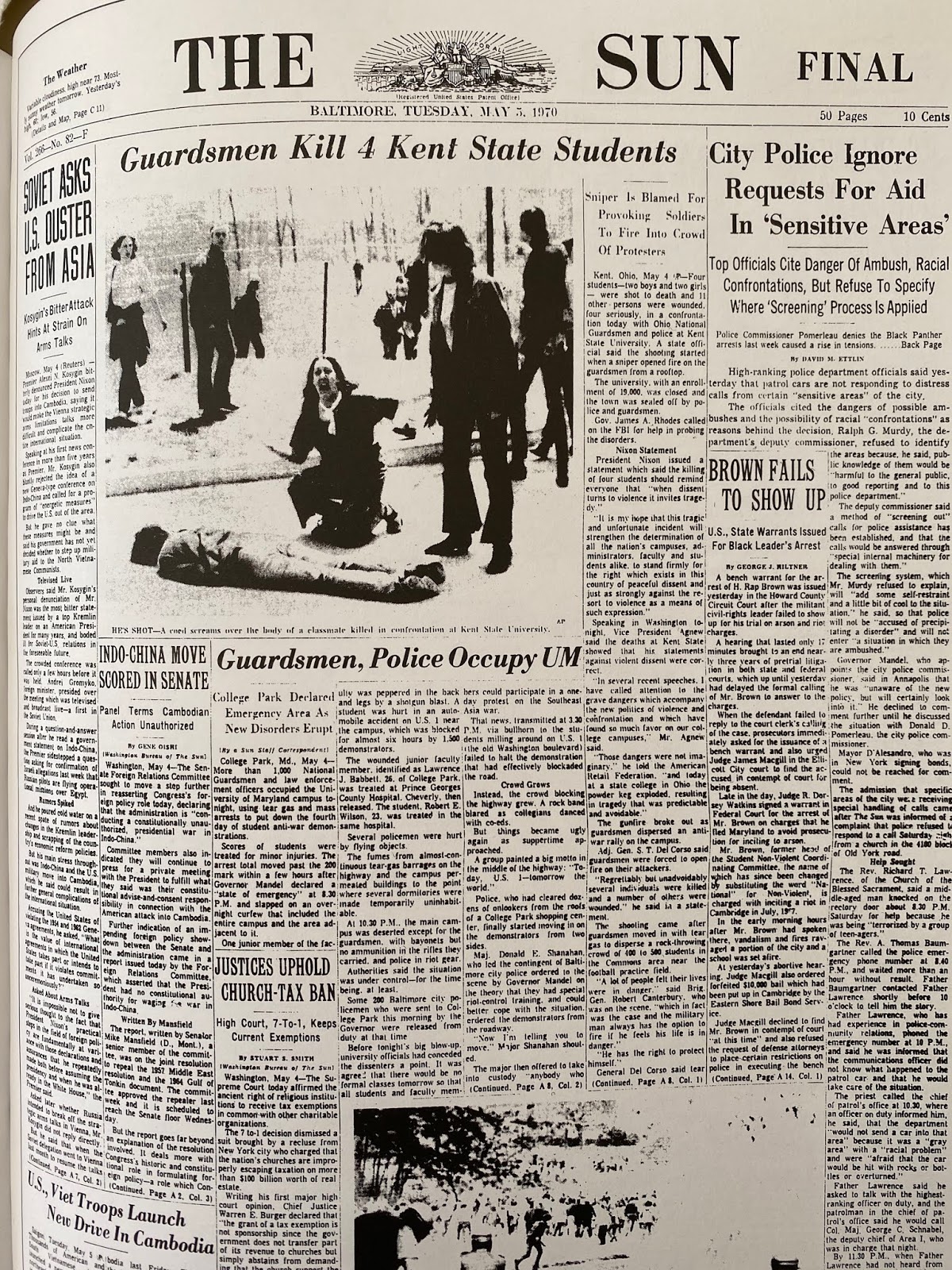
It was 8:30 on a Saturday night when the story began -- a middle-aged man knocking on the door of a Catholic church rectory on Baltimore's Old York Road seeking help, telling a priest  he was being "terrorized by a group of teen-agers."

Another priest called the city police emergency number. And then they waited. And waited. In the ensuing hours, Father Richard T. Lawrence tried to navigate by phone through the chain of command, but was unable to get beyond the patrolman manning the office of the night commander, Maj. George C. Schnabel. When he called again, the same patrol officer informed the priest that the major had flatly refused to send a patrol car to the area.

Two days later, Father Lawrence reached out elsewhere -- calling the Baltimore Sun, where this young reporter arriving for work on a noon general assignment shift was handed the story to check out. It was a Monday, and bigger news was breaking elsewhere in America and Maryland, but the priest's complaint became the lead story of the next day's front page.

Turned out, the police department had stopped responding to calls from areas near the home bases of half a dozen organizations deemed to be black militants. "We're not responding to certain areas on a selective basis," Col. Frank J. Battaglia, the chief of patrol, told me, "in areas where we may have a confrontation."

The church rectory was more than a city block from the home of a group called Making a Nation, on Cator Avenue. The space between was informally referred to as "a gray area" -- and the police were not responding there.

The story won my first front-page byline, and showed a measure of importance for issues of race relations in Baltimore -- which has not really changed much since.

That story appeared exactly 50 years ago today, and can be readily found in a coffee table-size book published by the newspaper in 1999 titled "A Century in The Sun: Front Pages of the 20th Century."
In the context of history, my story was vastly overplayed on what was then an eight-column page. 

Next to it, across five columns, was an eventual Pulitzer Prize-winning photo by photojournalism student John Filo of a teenager, her arms spread in anguish as she knelt over the body of a student killed by Ohio National Guard gunfire during an antiwar demonstration at Kent State University.

In all, four students were killed and nine injured as the guardsmen tried to disperse hundreds of demonstrators on campus. And a story under the photo reported that police and Guard troops had been ordered to occupy the University of Maryland's College Park campus. "College Park Declared Emergency Area As New Disorders Erupt," the headline read. A bottom-page photo showed state police using tear gas to disperse a crowd of demonstrators there.

Kent State and its reaction across America marked a homefront turning point in the antiwar movement, but the Vietnam combat grinded on another five years -- and not the last of ultimately useless wars for this nation, as witness Iraq and Afghanistan.

Likewise for race relations in Baltimore.

My slightly overplayed story on "gray areas" was flanked by an article on state and federal arrest warrants being issued for black militant H. Rap Brown after he failed to appear for trial on riot and arson charges,   and there was a "reefer" under my headline to a back page story on Baltimore's police commissioner denying that arrests a week earlier of Black Panther members caused a rise in tensions.

Gov. Marvin Mandel, who in those days had oversight on the city police chief, ordered an investigation of the "gray areas" incident, which quickly determined that the commissioner had ordered no response to calls from the half-dozen addresses of militant groups without the presence of a ranking officer. The order was misinterpreted, however, as subordinates simply avoided response even to areas nearby.

I was sent to police headquarters to interview the commissioner, Donald D. Pomerleau, but he was having none of it. His secretary said he was too busy to see me, so I told her I'd wait. I sat there for five hours. Came 5 o'clock, and the secretary turned off the lights and told me he was gone.

What has not gone in the 50 years since is the issue of race in Baltimore, as witness the "uprising" of five years ago, after the fatal injury of the arrested Freddie Gray in a police van that still divides the city. And race continues to be a component of nearly every aspect of life in the city -- education, health, housing, economics, politics. The current mayoral election features a handful of credible black candidates, and one white female candidate. A recent political ad for a black candidate purported to show the geographic pattern of her campaign donations as a swath of the city through its predominately white population centers.

And there is the issue of race in public safety, and distrust of police by much of the black community not just because of the Freddie Gray death. It has been exacerbated by the scandal of the police department's rogue Gun Trace Task Force, many of whose members (not all of them white) falsified evidence, stole money and drugs in raids and arrests, and ended up in prison themselves.

Fifty years and running, and what has changed in our society?


Monday, May 4, 2015

Turmoil then and now


Artist Nether works on his Freddie Gray mural. (Photo by Bonnie J. Schupp)

Racial tension haunts Baltimore

across chasm of 45 years

Today marks the 45th anniversary of Ohio National Guard soldiers fatally shooting four students during a protest of the Vietnam War at Kent State University. The eventual Pulitzer Prize-winning photo of a young girl kneeling in anguish over the body of one of the slain students ran atop the front page of newspapers across the world.

In the next morning's edition of The Baltimore Sun, the Kent State story ran under the picture. But the lede story -- at the top right of the page -- carried my first front-page byline, and had nothing to do with the shootings or the increasingly unpopular war that was raging in Southeast Asia.

My story was about policing and racial tension in the City of Baltimore.

You don't see much these days about war protests, even though America has been at war for close to 14 years in Afghanistan and Iraq.

But racial tension is back in the news in Charm City, in the wake of the arrest by city police officers, and subsequent death, of 25-year-old Freddie Gray in a westside neighborhood little changed economically or demographically since the rioting here and elsewhere that followed the 1968 murder of the Rev. Martin Luther King Jr.

My story began with a call to the city desk by a priest at a Catholic church along Old York Road, about two miles north of the central downtown area. A man who had been robbed had come knocking at rectory door in the wee hours, seeking help. To the priest's astonishment when he called the police, he was told that officers could not respond there because it was a "gray area."

It turned out there were half a dozen so-called "gray areas" around the city, each of them near the location of headquarters of what were perceived as black militant groups. In this case, it was a group called Making a Nation, located more than a block away on Cator Avenue.  The fact that the city police were refusing response to portions of Baltimore out of fear of provoking racial unrest was stunning enough to make it the top front-page story in Baltimore the next morning.

Not many people remember my story. Kent State, however, was and remains a watershed moment in American history.

The "gray areas" fiasco proved to be misinterpretation of a directive issued by then-police commissioner Donald D. Pomerleau for officers not to respond to any of the addresses occupied by black  militant groups without the presence of supervisory personnel.

You don't hear the term "black militant groups" in Baltimore these days. More often, you hear about street violence and gang disputes over drug territory. The 2015 gang roll call: Crips, Bloods, Black Guerrilla Family. They were more about turf control for drug dealing and crime than addressing racial inequities in Baltimore -- until last week, when gang leaders came together seeking to discourage the rioting and disorder that brought a surge of thousands of police officers and National Guard soldiers into  town.

In 1970, Baltimore was a powder keg of racial tension. It was just two years after the King riots, whites were fleeing to the suburbs in ever-increasing numbers, the downtown shopping district was in its  death throes, and police were trying to avoid confrontations that might make matters worse.

Forty-five years later, the city population has shrunk to about 630,000. Parts of Baltimore look like ghost towns for all the vacant buildings. Poverty is endemic, opportunity elusive. The American Dream -- well, what is it? Does it even exist in cities like Baltimore? Or is it just an American Nightmare now.

Today, driving through town, we were passing through a section where a week ago young people had been throwing rocks and bottles at riot-equipped cops in skirmishes broadcast live on television, globally. It was an explosion of the racial powder keg, again.

At the intersection of Mount and Presbury streets, an outdoor mural artist who uses the name Nether was rolling brown paint to create a giant image of Freddie Gray's face, flanked by a scene of marchers for social justice.

There was not a police officer or soldier in sight.

Wednesday, April 29, 2015

Baltimore's Riot of 2015


In the matter of Freddie Gray

the 'routine' has vastly changed


During a 40-year career in the news business, I came up with my "two first laws of journalism": 

No. 1 is "Cops Lie."

No. 2 is "Cops can't spell."

I mean no disrespect for officers of the law. I like most cops I've met. But I deemed it important for folks in the news business to understand that cops are very much like other folks you meet -- they do not always tell the truth or get things right.

Face it -- everybody lies. Maybe not all the time, but sometimes. And who hasn't made a spelling error? The point is to understand that information you are being given may not be accurate or true. Journalists have an obligation to check facts and get other points of view. Truth can be elusive, perhaps not even possible to ascertain.

I learned about cops lying -- or perhaps not telling all the truth -- as a young police reporter at The Baltimore Sun nearly half a century ago. A tactical squad sergeant invited me to go along on drug investigations and raids with his team of about half a dozen men. But I had to make a deal with the devil. I might witness some activities that I had to agree not to report in my story.

The first such incident came as the cops were trying to locate a drug dealer, and leaned on his mentally slow brother-in-law for information, stopping by the man's tiny street-level apartment in pre-urban renewal South Baltimore. They told the man he faced arrest for drug possession and, to his denials, got him to agree to a search of his dwelling. As they rummaged around, one of the officers planted a packet of powder under a lamp, then "found" the supposed drugs. The guy was scared. And then, to avoid arrest, he told the team where to find his brother-in-law's drug stash nearby.

That was a little deception, a warrantless search -- a shakedown, really --  at the expense of a simple-minded citizen of Baltimore to get what they wanted. And it was part of the investigative process that I was bound by our agreement not to report.

Which brings us to Pennsylvania Avenue, in 1969 an epicenter of illegal drug activity -- and this week, an epicenter of the protests over the strange death in police custody of Freddie Gray.

It was another investigation here by the squad, this time with a search warrant for a building that had a padlocked front door. Two men sitting on folding chairs on the sidewalk in front of that building were detained, while the squad broke open the padlock and began combing through a 3-foot-deep heap of trash piled inside. They found, at the bottom of a trash can under the pile of debris, a plastic bag containing filled drug capsules.

Neither of the suspects resided in the building, and neither had a key to the padlock. Neither was holding drugs. They had been sitting in chairs on a public sidewalk. And they were charged with possession with intent to distribute narcotics.

In the official report on their arrest on drug charges, the cops wrote that the men were "on the premises."

As distasteful I deemed their deception in the case of the feeble-minded brother-in-law, which I was unable to recount in my story, I realized in the Pennsylvania Avenue arrests that the cops were lying in their official report -- and this time, I was free to write the circumstances of the search and arrests, and quote from the official report by the police that the suspects had been "on the premises."
They were not in jail very long. Defense lawyers noted my first-hand account as proof that the men had been outside the premises -- not on the premises. 

I asked the sergeant about that, and whether the men his team had arrested were in fact guilty. "They were dealing drugs, Dave," was the sergeant's reply. "Maybe not there, but they were drug dealers."
"On the premises" was an example of using vague language to avoid the truth. It was so routine that the cops hardly saw it as lying. 

Which brings us, 46 years later, to the death of 25-year-old Freddie Gray, whose arrest on April 12 was partially recorded on video -- just the last seconds, in which he was shown face-down on a sidewalk, a cop on either side of him, and then, seeming unable to walk, dragged to the back of a prisoner transport van. He was shouting in apparent pain.

Police reported that Gray had been "arrested without incident."

It is a phrase so routine, perhaps the officers themselves could not see it as untrue. From their point of view, Gray's arrest was routine. He had made eye contact with them, then ran, and he was chased, caught, handcuffed and loaded into the van. That's what they do.

But it was hardly routine for Freddie Gray, whose short life was marred by childhood exposure to lead dust in his mother's cheap rental home and later a long rap sheet of drug arrests.

Sometime between eye contact and Gray becoming unresponsive and not breathing, his spinal cord had been snapped. He died a week later.

The death became Baltimore's Missouri Moment -- its turn in the global spotlight, with angry demonstrations following deaths at the hands of police  in Ferguson, Mo., New York City and other communities. Charm City, one of the local and usually ludicrous nicknames, is under a State of Emergency and occupied by National Guard soldiers after the demonstrations grew into a riot of looting, burning and violence.

Later this week, police promise a fuller report on Gray's arrest and death as the department turns over the investigation to the Baltimore state's attorney's office -- the prosecutorial arm of the criminal justice system. Meanwhile, six police officers involved with the arrest and transport of Freddie Gray remain suspended with pay.

And key questions from a period of some 30 minutes remain unanswered -- starting with what was the "probable cause" for Freddie Gray's arrest. The joke, of course, is that he was simply "running while black." And how could his spinal cord have snapped? Before that bystander's video began, did an officer have a knee resting on Gray's neck? Left unattended and without a safety restraint in the caged confines of the transport van, was he given a "rough ride" to the police station?

Nothing here is simple, other than the public response to deaths at the hands of or in custody of police in a nation that has changed, remarkably, since the 1960s. 

What once was routine is anything but.